Form 1099-DA Explained for UK Residents Using US Exchanges

Published 13 June 2026· Reviewed against gov.uk 25 August 2026· 9 min read·US crypto tax
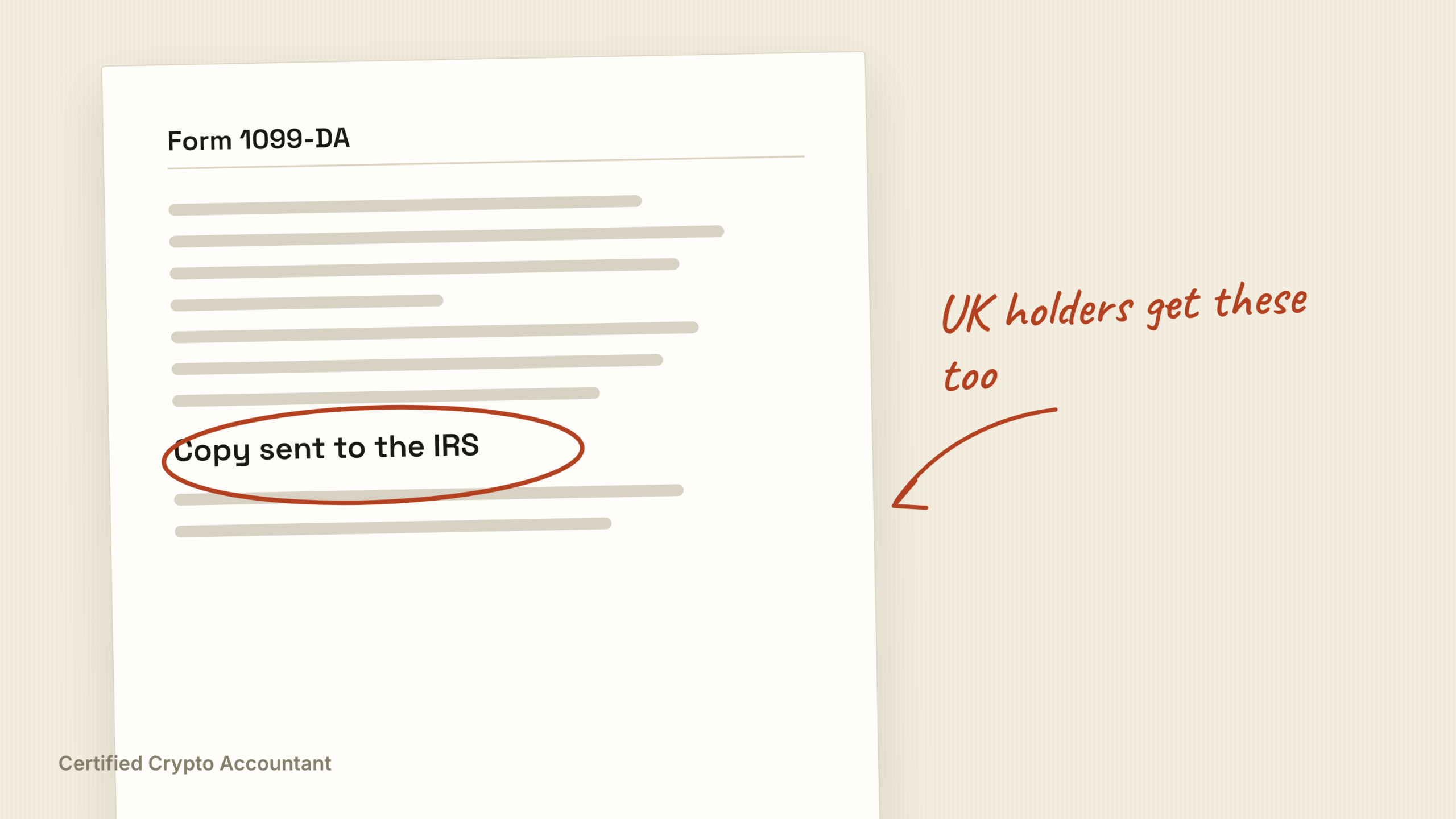
If you are a UK resident who trades crypto on a US exchange, a new piece of paper may have just landed in your account or inbox: a Form 1099-DA. For most people it triggers the same two questions, in this order: what is it, and am I now somehow in trouble with the US tax authorities? The short answer on 1099-DA UK situations is that the form is a US reporting document, not a UK tax demand, and for a typical UK resident who is not a US taxpayer it changes nothing about what you actually owe.
That said, the form is a strong signal. It means a US broker has logged your disposals, sent that data to the IRS, and that your crypto activity is now visible to a tax authority. Your real obligation still sits with HMRC, who tax you on your worldwide gains. This guide untangles the UK and US overlap so you know exactly who reports what, what the form covers, and the one form that decides whether you are treated as a US person or a foreign one.
What is Form 1099-DA and why have I, a UK resident, received one?
Form 1099-DA is a US information return covering sales and dispositions of digital assets. US custodial brokers, the larger centralised exchanges such as Coinbase, Kraken, Gemini and Binance.US, must issue it from the 2025 tax year onwards. It is the crypto equivalent of the long-standing 1099-B used for shares.
Here is the part most guides miss. A broker should generally not issue a 1099-DA to a customer who is properly documented as a non-US person on a valid Form W-8BEN. So if one has arrived, the most common reason is a documentation problem. Your W-8BEN is missing, has expired, or the exchange has treated you as a US person under its default rules. Receiving the form does not mean the IRS believes you owe US tax. It means a US institution has reported your activity, and it is your cue to check what certification the exchange actually holds for you.
For a UK resident who is not a US citizen, green-card holder or otherwise a US taxpayer, the 1099-DA is informational. It is evidence of what you traded, not a calculation of UK tax. Your job is to make sure that activity is correctly reported where it actually counts: on your UK Self Assessment return.
What does the 1099-DA actually report, and how does it change by year?
The reporting is being phased in. For the 2025 tax year, brokers report gross proceeds only, the total value you sold or disposed of, with no deduction for what you paid. Cost-basis reporting, the purchase price needed to work out an actual gain, becomes required from 1 January 2026 (the 2026 tax year).
This matters. A 2025 form showing large gross proceeds can look alarming because it ignores your costs entirely. The form reports in US dollars. If you bought crypto for the equivalent of £40,000 and sold it for £42,000, the form may show the dollar equivalent of the full £42,000 as proceeds while your actual gain is only £2,000. The proceeds number is not your profit.
| Tax year | What the broker reports | What you still need |
|---|---|---|
| 2025 (forms issued early 2026) | Gross proceeds only | Your own cost-basis records to work out the gain |
| 2026 onwards | Gross proceeds and cost basis | Reconciliation across all wallets and exchanges |
The 2025 forms were provided to customers in early 2026, typically between February and mid-March, and filed with the IRS at the same time.
W-9 versus W-8BEN, the form that decides your status
When you opened your US-exchange account, you were asked to certify your tax status. This single choice determines how the platform, and the IRS, treats you.
- Form W-9 is completed by US persons: US citizens, green-card holders and US tax residents. It gives the broker a US Taxpayer Identification Number and signals that you are inside the US tax system.
- Form W-8BEN is completed by non-US persons, including UK residents who are not US taxpayers. It certifies your foreign status and lets you claim benefits under the US/UK double tax treaty.
If you are a UK resident with no US tax status, a W-8BEN is what you should have on file. If you mistakenly completed a W-9, the exchange may treat you as a US person, which can lead to the wrong reporting and, on some income types, US withholding. Getting this certification right is the foundation of the whole UK/US picture.
| Feature | Form W-9 | Form W-8BEN |
|---|---|---|
| Who completes it | US persons (citizens, green-card holders, US residents) | Non-US persons, including UK residents who are not US taxpayers |
| What it certifies | US status and US Taxpayer Identification Number | Foreign status as beneficial owner |
| Treaty benefits | Not applicable | Can claim reduced US withholding under the US/UK treaty |
| Typical UK resident | Only if also a US taxpayer | The correct default |
Who do I actually report to? HMRC, the IRS, or both?
This is where most of the panic comes from, and it is simpler than it looks once you separate the two systems.
A UK resident is taxed by HMRC on their worldwide gains and income, including crypto, regardless of where the exchange sits or whether a US form arrives. The 1099-DA is a US document. It does not replace, reduce or satisfy your UK reporting. You report your crypto disposals to HMRC through Self Assessment, calculating gains in pounds using UK rules such as share pooling and the same-day and 30-day matching rules.
The IRS angle only becomes a live UK/US issue if you are a US person. US citizens and green-card holders living in the UK must file US returns as well as UK ones. The good news is that the US/UK double tax treaty and foreign tax credits are designed to stop the same income being taxed twice, so the two systems offset rather than stack. For a non-US UK resident, there is no US filing arising simply from holding crypto on a US exchange.
One more point that catches people out: even without a 1099-DA, you must still self-report all crypto disposals. The form is a prompt, not the trigger for your obligation. HMRC does not wait for a US document, and from 1 January 2026 the UK’s own Crypto-Asset Reporting Framework (CARF) means HMRC will receive similar transaction data directly, so mismatches between what you filed and what exchanges reported are easy to detect.
Worked example, a UK resident with US-exchange disposals
Amira is UK resident, not a US citizen, and opened her US-exchange account years ago. Her W-8BEN certification lapsed without her noticing, so the exchange treated her as reportable and issued a 1099-DA for the 2025 tax year showing gross proceeds equivalent to around £30,000, proceeds only, because that is all the 2025 form reports.
That £30,000 is not her gain. Reconciling her records, she finds she originally bought the Ethereum for £22,000, giving an actual capital gain of £8,000.
- US position: as a non-US person, Amira has no US tax return to file on this disposal. She re-certifies her foreign status with a fresh W-8BEN so the exchange stops reporting her as if she were a US person.
- UK position: Amira reports the £8,000 gain to HMRC on her Self Assessment return. After applying her annual capital gains exempt amount, the remaining gain is taxed at the UK capital gains rate that applies to her, and that is the tax she actually pays.
The lesson: the alarming US number was gross proceeds, the real liability was UK CGT on the £8,000 gain, and the two systems never collided. Had she relied on the 1099-DA figure as her profit, she would have wildly over-stated her gain.
How a specialist handles a 1099-DA UK case
When a UK client forwards a 1099-DA, we work in one order: status first, numbers second. We confirm whether you are a US person or a non-US person, check that the right certification (W-9 or W-8BEN) is on file, and then ignore the US proceeds figure as a profit number entirely. We reconcile every wallet and exchange to establish the true UK gain in pounds, report it correctly to HMRC, and, where a client is also a US taxpayer, coordinate the US return so treaty relief and foreign tax credits prevent double taxation. Dual UK and US handling under one roof is exactly where these cases are won or lost.
Frequently asked questions
Does receiving a 1099-DA mean I owe US tax?
Not for a typical UK resident who is not a US taxpayer. The 1099-DA is an information return reporting your activity to the IRS. Your tax is owed to HMRC on your worldwide gains, and the form does not create a US liability by itself. It is worth checking why you received one at all, since a valid W-8BEN on file should normally prevent it.
I am a UK resident. Should I have filed a W-9 or a W-8BEN?
A W-8BEN, which certifies your foreign status and lets you claim US/UK treaty benefits. Form W-9 is for US persons. If you filed a W-9 in error, you should correct it with the exchange, as it can cause the wrong reporting and unnecessary US withholding.
The proceeds figure on my 1099-DA looks huge. Is that my profit?
No. For the 2025 tax year the form reports gross proceeds only, the total sold, with no deduction for what you paid. Your gain is proceeds minus cost basis, which you calculate from your own records until cost-basis reporting begins from 2026.
Do I still report to HMRC if I never received a 1099-DA?
Yes. You must self-report all crypto disposals to HMRC whether or not any form arrives. The 1099-DA is a US document and is not a precondition for your UK obligation.
I am a US citizen living in the UK. What is different for me?
You must file US returns as well as UK ones, because the US taxes its citizens worldwide. The US/UK double tax treaty and foreign tax credits are designed to prevent the same income being taxed twice, so the systems offset rather than double up. This needs careful coordination.
Will HMRC find out about my US-exchange activity anyway?
Increasingly, yes. From 1 January 2026 the UK’s CARF regime means exchanges report transaction data to HMRC, mirroring the US position. Tax authorities also share data internationally, so under-reporting is far easier to detect than it used to be.
Get your UK position straight before you reply
A 1099-DA is not something to panic about, but it is something to handle correctly. The right move is to confirm your status, treat the proceeds figure as data rather than profit, and report the real gain where it belongs. If you are also a US taxpayer, the UK and US sides need to be coordinated so you claim every relief available and never pay twice. Book a free, confidential review at certifiedcryptoaccountant.com.
For tailored help, see our crypto tax services or book a free review.
Authoritative sources: IRS: Digital Assets; HMRC Cryptoassets Manual.
The full set of UK rules sits on our crypto tax UK guide. If you would rather someone else did the pooling and the pounds-sterling conversions, that is what our crypto tax accountants are for.
Sources
Every figure on this page was checked against the source below on 25 August 2026.
- IRS's form guidance. Internal Revenue Service, checked 25 August 2026
- Nullified by Congress in April 2025. US Congress, checked 25 August 2026
- IRS: Digital Assets. Internal Revenue Service, checked 25 August 2026
- HMRC Cryptoassets Manual. GOV.UK, checked 25 August 2026
Fahad Zar
Crypto tax accountantAAT licensed 1010475
- AAT Licensed Accountant and MAAT, licence 1010475
- MSc Accounting and Finance, BPP University London
- Six years inside digital asset accounting, across several crypto tax firms
- Practises through Zar Enterprises Ltd, ICO registration ZC225094
- Supervised for anti-money laundering by the AAT
What matters to me is that the number on the return is true, whatever it turns out to be.
Whether this is worth a conversation
Most people who read this page do not need an accountant. A few do.
- You file in both the UK and the US
- Your 1099 forms do not match your records
- A move across the Atlantic split your tax year
If you are US only with one exchange and clean 1099s, a domestic preparer covers it.
If one of these is you, the first look costs nothing.
Read next
Where to find your Crypto.com tax forms
Where to find your Crypto.com tax forms and statements in 2026, what each one covers, and how to turn them into a…
Reviewed 25 Aug 2026DeadlineCrypto tax deadlines for the 2026 to 2027 tax year
Key UK crypto tax dates for 2025/26: Self Assessment registration, the 31 January filing and payment deadline, and what…
Reviewed 25 Aug 2026