What your heirs will owe on crypto they inherit

Published 1 July 2026· Reviewed against gov.uk 25 August 2026· 7 min read·Gifts, estate and life events
When someone dies, their cryptoassets do not simply vanish or pass quietly to the next of kin. For crypto inheritance tax UK purposes, Bitcoin, Ethereum, NFTs and tokens are treated like any other property you own: they form part of your estate, they are valued at the date of death, and they can be subject to Inheritance Tax in the same way as a house, a share portfolio or a bank account. Yet crypto carries two problems no other asset class has.
The first is the tax problem: HMRC expects the date-of-death value of every coin and token to be counted towards the estate, and your heirs inherit those assets at that same value for their own future Capital Gains Tax. The second is the access problem: if nobody can find the private keys or seed phrase, the crypto may be effectively lost to your family while still counting towards the Inheritance Tax bill. This guide explains both, with verified figures, and how to plan for your heirs.
Is crypto subject to inheritance Tax in the UK?
Yes. There is no special exemption for digital assets. HMRC treats cryptoassets as property for tax purposes, and the HMRC Cryptoassets Manual is the primary guidance on how they are taxed during life and on death. When you die, the value of your crypto is added to everything else you own to arrive at the total value of your estate.
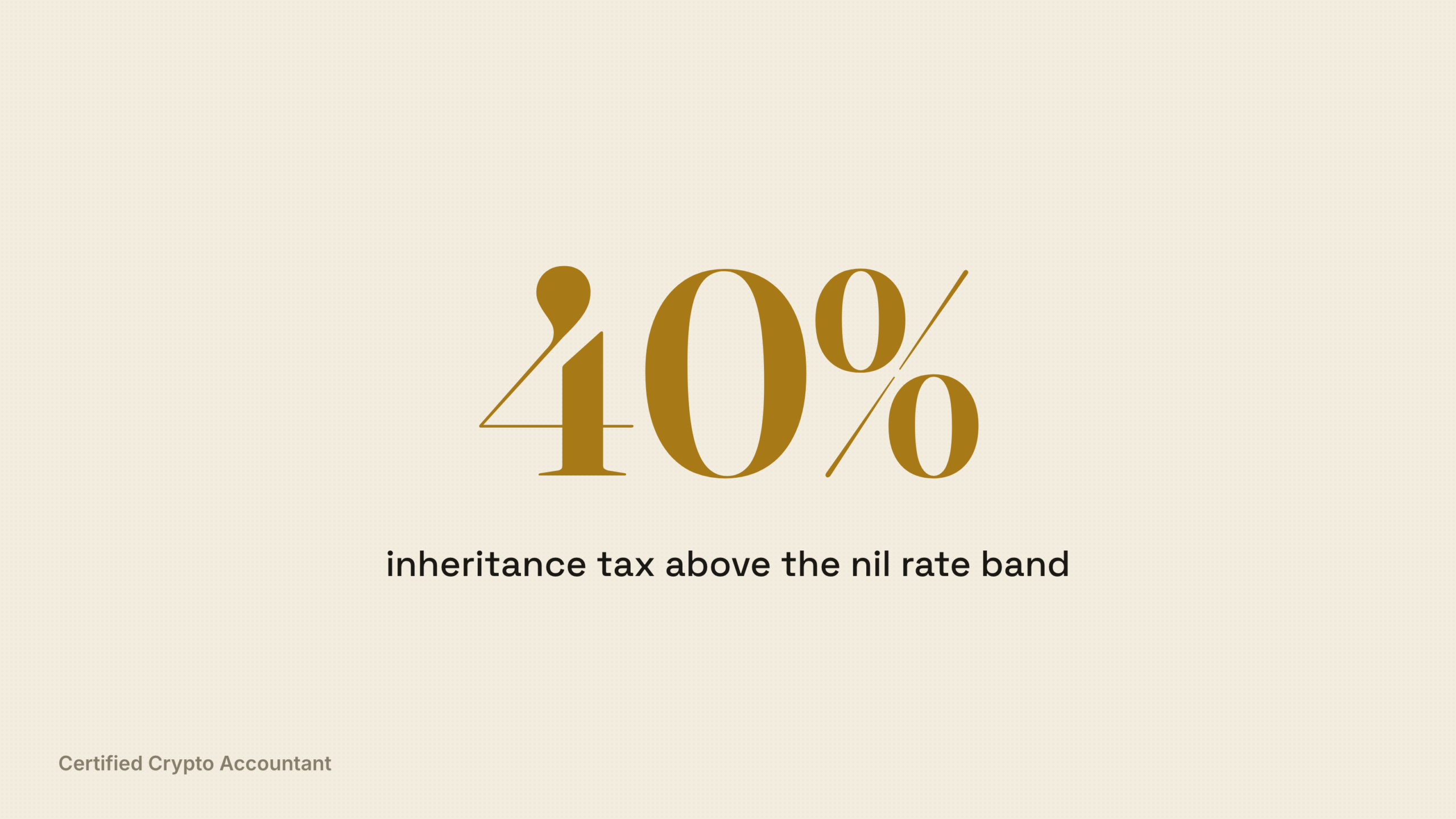
The standard Inheritance Tax position is straightforward in principle. There is normally no tax to pay if your estate is below the £325,000 nil-rate band, or if you leave everything above that threshold to your spouse, civil partner or a charity. Above the threshold, the standard rate is 40%, charged only on the portion of the estate that exceeds it. If you leave your main home to your children or grandchildren, an additional residence nil-rate band of £175,000 can apply, lifting the combined threshold to £500,000 for estates worth less than £2 million.
How is crypto valued for inheritance Tax?
Cryptoassets are valued at their market value at the date of death. That sounds simple until you remember how volatile crypto is: a portfolio worth £600,000 on the morning someone dies might be worth £400,000 a fortnight later, but the Inheritance Tax calculation looks to the date-of-death figure. Executors need a defensible record of the price of each asset on that day, drawn from reputable exchange data.
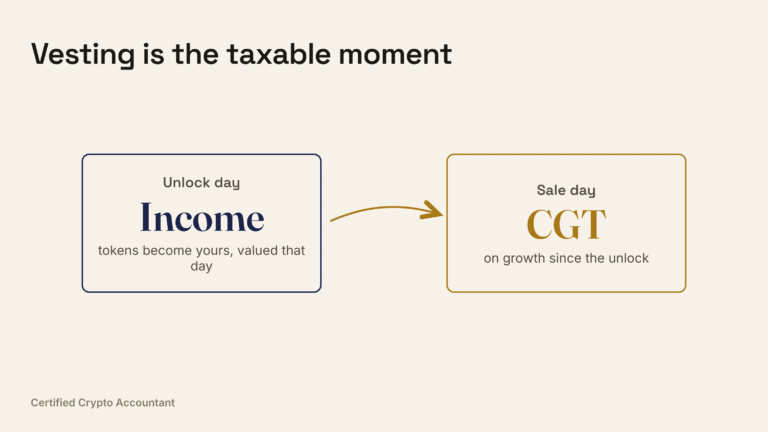
This valuation date does double duty, because the same date-of-death value becomes the beneficiary’s acquisition cost. Your heirs are treated as acquiring the assets at their market value at the date of death for future Capital Gains Tax, so a later gain is measured from that inherited value, not from whatever you originally paid. With the CGT annual exempt amount for 2026/27 set at just £3,000, an accurate valuation matters as much to the heirs as to the estate.
| Item | 2026/27 figure | Why it matters for crypto |
|---|---|---|
| IHT nil-rate band | £325,000 | Crypto value is added to the estate and counts towards this threshold. |
| Residence nil-rate band | £175,000 | Extra allowance if a main home passes to direct descendants (estate under £2m). |
| Standard IHT rate | 40% | Applied to the estate value, including crypto, above the threshold. |
| CGT annual exempt amount | £3,000 | Beneficiaries inherit at date-of-death value; gains above this are taxable on sale. |
The access problem, keys, seed phrases and lost crypto
Here is the difference between crypto and every other asset in an estate. A bank will release funds to executors who produce a grant of probate, and a registrar will transfer shares. But no authority can recover self-custodied crypto without the private keys or seed phrase. If those are lost, the coins remain visible on the blockchain and remain part of the estate, yet no one can move or sell them. The crypto can still count towards the estate for Inheritance Tax while being completely inaccessible, so in the worst cases an estate faces a tax bill on assets it cannot actually reach to pay that very bill.
Why you should never put a seed phrase in your will
The instinct to write the seed phrase straight into the will is understandable, and it is a serious mistake. Once probate is granted, a will becomes a public document that anyone can obtain a copy of. A seed phrase recorded in a will is therefore a set of keys published to the world, and whoever copies them first can drain the wallet, with no realistic prospect of recovery. The same caution applies to any document that might be filed or stored loosely, and to a single point of failure that could be lost in a house fire or flood.
The fix is to separate two things. The legal instructions about who inherits belong in the will, which can name the beneficiaries of your crypto without ever revealing how to reach it. The practical access details belong somewhere private and secure: a letter of wishes or a sealed instruction held with your solicitor, kept off probate. Just as important, tell your executors the crypto exists at all, because many estates have lost holdings simply because the family never knew there was a wallet to look for. A clear inventory of what exists and where the access instructions can be found, without spelling out the secrets, turns an impossible scavenger hunt into a manageable administration.
Worked example, crypto inheritance tax in practice
Daniel dies leaving an estate of £700,000: a self-custodied crypto portfolio valued at £250,000 at the date of death, plus £450,000 in a house and savings. He leaves everything to his adult daughter, and the home passes to her, so the residence nil-rate band applies.
- Combined threshold: £325,000 nil-rate band + £175,000 residence nil-rate band = £500,000.
- Estate above the threshold: £700,000 − £500,000 = £200,000.
- Inheritance Tax at 40%: £200,000 × 40% = £80,000.
His daughter inherits the crypto at its £250,000 date-of-death value. If she later sells it for £280,000, her gain is £30,000 measured from that inherited value, and after the £3,000 annual exempt amount, £27,000 would be within scope of Capital Gains Tax. Now consider the access problem: if Daniel had never recorded his seed phrase anywhere his executor could find it, that £250,000 might still sit in the estate valuation, driving the £80,000 tax bill, while being permanently unreachable.
How a specialist handles it
When a family comes to us after a death, we work in one order: establish what exists, value it correctly, then deal with the tax. We build a full inventory of wallets and exchange accounts, produce defensible date-of-death valuations from reliable price data, set the beneficiaries’ acquisition values for future Capital Gains Tax, and coordinate with the probate solicitor so the estate’s Inheritance Tax position is accurate and the access details never end up anywhere public.
Frequently asked questions
Is cryptocurrency subject to inheritance Tax in the UK?
Yes. Crypto is part of your estate on death and within scope of Inheritance Tax like any other property. Its date-of-death value is taxed at 40% on anything above the £325,000 nil-rate band, subject to the usual exemptions.
How is crypto valued for inheritance Tax?
At its market value at the date of death, using reputable exchange price data. Because crypto is volatile, executors need a clear, documented valuation for each asset on that exact date.
What value do beneficiaries inherit crypto at?
Beneficiaries are treated as acquiring the assets at their market value at the date of death. That figure becomes their acquisition cost for any future Capital Gains Tax when they sell.
What happens if nobody can find the private keys?
The crypto may be effectively lost while still potentially counting towards the estate for Inheritance Tax. The blockchain still shows the holdings, but without the keys or seed phrase no one can move them.
Can I put my seed phrase in my will?
No. Wills become public once probate is granted, so a seed phrase in a will is exposed to anyone who obtains a copy. Keep recovery details in a secure letter of wishes, separate from the will.
How do I make sure my executors know my crypto exists?
Leave a clear inventory of what you hold and where the access instructions can be found, stored securely and off probate. Tell your executors it exists so they know to look for it, without writing the secrets into any public document.
Plan your crypto estate before your heirs have to
Crypto inheritance is where the tax problem and the access problem collide, and getting either one wrong can be costly or irreversible. If you hold cryptoassets, the time to sort your valuations, your inventory and your secure access plan is now, not after the fact. Book a free, confidential review at certifiedcryptoaccountant.com and ask about our crypto tax services for individuals, families and estates across the UK.
The full set of UK rules sits on our crypto tax UK guide. If you would rather someone else did the pooling and the pounds-sterling conversions, that is what our crypto tax accountants are for.
Sources
Every figure on this page was checked against the source below on 25 August 2026.
- Inheritance Tax. GOV.UK, checked 25 August 2026
- HMRC Cryptoassets Manual. GOV.UK, checked 25 August 2026
- Capital Gains Tax. GOV.UK, checked 25 August 2026
Fahad Zar
Crypto tax accountantAAT licensed 1010475
- AAT Licensed Accountant and MAAT, licence 1010475
- MSc Accounting and Finance, BPP University London
- Six years inside digital asset accounting, across several crypto tax firms
- Practises through Zar Enterprises Ltd, ICO registration ZC225094
- Supervised for anti-money laundering by the AAT
What matters to me is that the number on the return is true, whatever it turns out to be.
Whether this is worth a conversation
Most people who read this page do not need an accountant. A few do.
- Assets are moving inside the family
- An estate you manage holds crypto
- A separation is splitting the holdings
If you are gifting to your spouse with no other moving parts, the transfer is already tax free.
If one of these is you, the first look costs nothing.
Read next
How crypto is split and taxed in a UK divorce
Splitting crypto in a UK divorce: transfers between spouses, the no gain no loss window, and the Capital Gains Tax…
Reviewed 25 Aug 2026DeadlineCrypto tax deadlines for the 2026 to 2027 tax year
Key UK crypto tax dates for 2025/26: Self Assessment registration, the 31 January filing and payment deadline, and what…
Reviewed 25 Aug 2026