Adding liquidity to Uniswap is a taxable disposal

Published 17 June 2026· Reviewed against gov.uk 25 August 2026· 7 min read·DeFi, staking and earning
If you have ever added tokens to a Uniswap, Curve or Balancer pool, you may have triggered a taxable event without realising it. The rules on liquidity pool tax UK treatment are not in plain sight, but HMRC’s reasoning is clear enough: the moment you deposit tokens into an automated market maker (AMM) and receive LP (liquidity provider) tokens back, you have, in HMRC’s likely view, disposed of one asset and acquired a different one. That is a capital gains event, even with no cash leaving your wallet.
This is the hidden disposal that catches active DeFi users: someone who moves in and out of pools chasing yield can rack up dozens of unreported disposals in a tax year. This guide explains how providing liquidity is taxed in the UK: why the LP token matters, what happens on withdrawal, how fees and rewards are treated, and where impermanent loss helps and where it does not.
What does liquidity pool tax UK treatment actually mean?
An AMM such as Uniswap, Curve or Balancer lets users trade against a shared pool of tokens. Liquidity providers deposit pairs of tokens and receive LP tokens, which represent their share of the pool and their claim on the fees it generates.
For tax, the question is whether handing your tokens to the pool is a disposal for Capital Gains Tax. HMRC’s definition of a disposal includes “exchanging tokens for a different type of token”, and the DeFi guidance in the HMRC Cryptoassets Manual applies the same beneficial-ownership reasoning to liquidity pools.
Why depositing tokens into a pool is a disposal
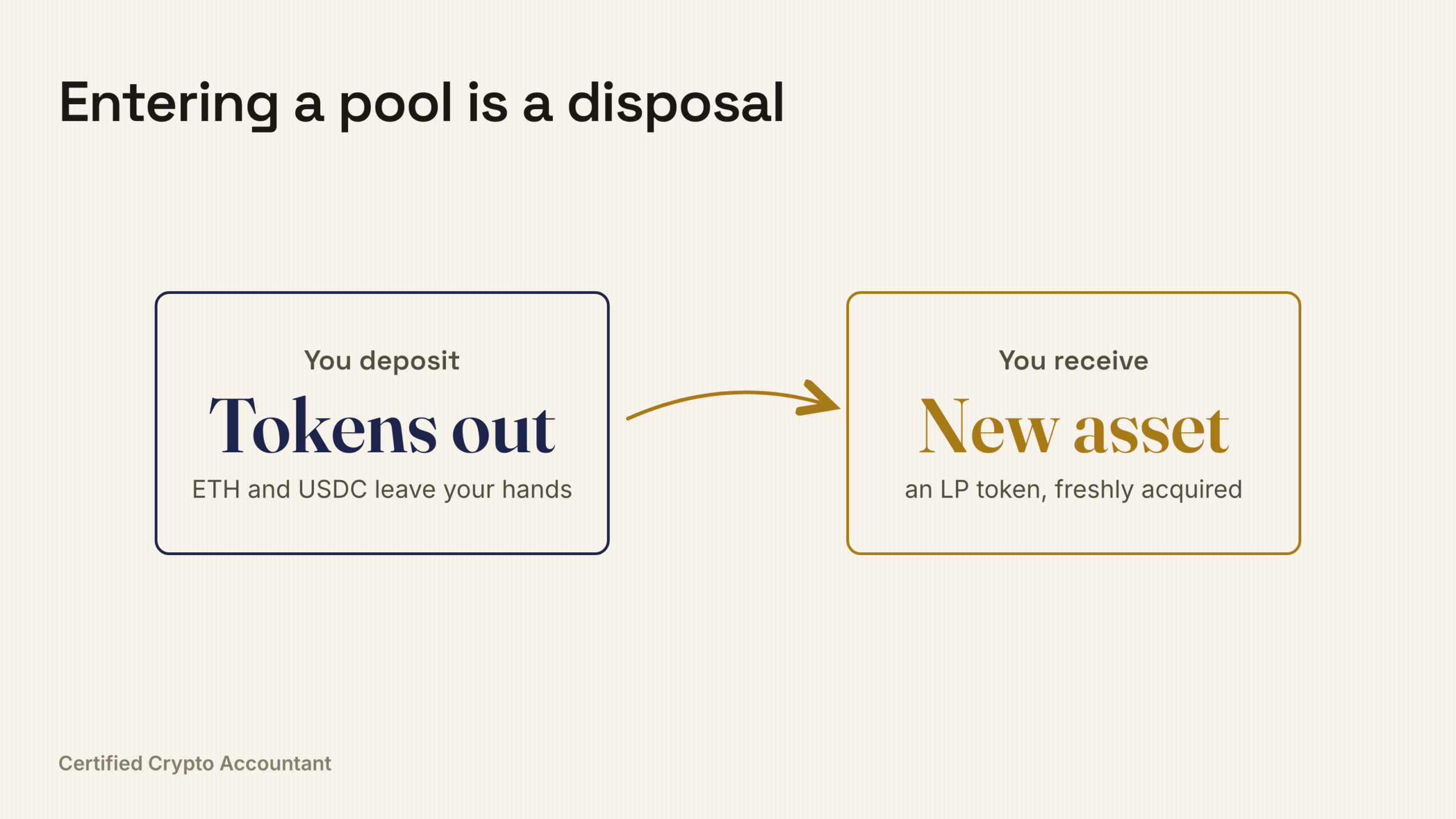
The crucial point is beneficial ownership. When you deposit ETH and USDC into a Uniswap pool, you no longer hold those exact tokens: they join a shared reserve the protocol can deal with freely, and you hold an LP token instead. HMRC’s DeFi guidance on making a DeFi loan or providing liquidity says that where the provider transfers beneficial ownership for a different token, that is an exchange and a disposal.
So two things happen at deposit. You dispose of the tokens you put in, at their sterling market value, triggering a gain or loss against their Capital Gains Tax base cost, and you acquire the LP token at a base cost equal to the value handed over. The gain is “dry”: you can owe tax with no cash in sight, which is why it is missed.
The LP token is a new asset, and removing liquidity is a second disposal
The LP token is not just a receipt. For tax it is an asset in its own right, with its own base cost in its own Section 104 pool. Pooling is per person, and the matching order is same-day, then the 30-day rule, then the Section 104 pool.
So when you exit the pool, you hand the LP token back and receive tokens in return. That is another exchange: you dispose of the LP token and acquire the tokens that come out. A single round trip into and out of one pool can therefore create multiple disposals:
- Disposal of each token you deposited.
- Acquisition of the LP token.
- Disposal of the LP token on withdrawal.
- Acquisition of the tokens you withdraw, at market value.
Multiply that across every pool and rebalance, and a trader who hopped between five pools in a year can easily face dozens of reportable disposals.
How fees and reward tokens are taxed
Liquidity providers earn returns in two broad ways, and the treatment depends on the nature of the return, per HMRC’s guidance on the nature of a DeFi return.
| Type of return | How it usually works | Likely tax treatment |
|---|---|---|
| Trading fees inside the pool | Accrue to the pool and lift your LP token’s value | Often part of the capital return, realised on disposal of the LP token |
| Separate reward or governance tokens | Paid to you as extra “farming” incentives | Generally income tax at market value on receipt, which becomes the CGT base cost |
Crypto income is taxed at its sterling market value on receipt, which becomes the CGT base cost. The income-versus-capital line is not always obvious, and a specialist will pin it down per protocol.
Impermanent loss is not automatically a tax loss
Impermanent loss is the gap between holding tokens in a pool and holding them in your wallet, caused by price moves between the paired assets. For tax it is not a loss until realised, so you cannot claim it while your liquidity remains in the pool. A capital loss arises only when you dispose of the LP token or underlying tokens and crystallise a real loss against base cost, which can then offset gains.
Worked example, one round trip, two taxable events
Alex is a higher-rate taxpayer in 2025/26. He adds liquidity to a Uniswap ETH/USDC pool, depositing ETH and USDC each worth £15,000, and receives LP tokens worth £30,000.
- ETH leg: Section 104 base cost £6,000, value on deposit £15,000, so the gain is £15,000 minus £6,000 = £9,000.
- USDC leg: base cost £15,000, value £15,000, so the gain is £0.
- LP token acquired: base cost £30,000.
His total gain on this deposit is £9,000. After the 2025/26 annual exempt amount of £3,000, the taxable gain is £6,000. CGT on crypto disposals from 30 October 2024 is 24% above the basic-rate band, so the tax is £6,000 × 24% = £1,440.
And that is only the deposit. When Alex later removes liquidity, handing back the LP token triggers a second disposal against its £30,000 base cost: two taxable events from one pool, no cash involved.
How a specialist handles it
When a DeFi-heavy client comes to us, we work data first. We pull every wallet and on-chain interaction, identify each pool entry and exit, value every leg in sterling on the right date, and rebuild the Section 104 pools for the underlying tokens and the LP tokens. We separate income from capital, apply the matching rules, and produce a defensible year-by-year position. Where past years were missed, we use the proper route to tell HMRC about unpaid tax on cryptoassets.
Frequently asked questions
Is providing liquidity to uniswap or curve taxable in the UK?
On HMRC’s likely position, yes. Depositing tokens and receiving LP tokens is treated as exchanging one asset for a different one: a disposal for Capital Gains Tax at market value, even though no cash changes hands.
Do I pay tax even if I never sold for pounds?
Yes. A crypto-to-crypto exchange is a disposal. Swapping tokens for an LP token, and later swapping it back, are both disposals even if you never convert to GBP.
How is the LP token treated for tax?
It is a separate asset with its own base cost, equal to the value of the tokens you deposited, in its own Section 104 pool. Disposing of it on withdrawal is a fresh taxable event.
Are liquidity mining rewards income or capital?
It depends on their nature. Separate reward or governance tokens are generally income tax at market value on receipt. Trading fees that build up inside the pool tend to form part of the capital return realised on disposal of the LP token.
Can I claim impermanent loss as a tax loss?
Not while your liquidity is still in the pool. It becomes a capital loss only when you dispose of the LP token or underlying tokens and realise a real loss against your base cost.
What if I have entered and exited many pools and never reported any of it?
You likely have a string of unreported disposals. The safest route is to reconcile your full history and disclose to HMRC. Coming forward voluntarily keeps penalties far lower than waiting to be found.
Get your DeFi position reviewed before HMRC asks
Liquidity pools are one of the easiest ways to build up unreported disposals without touching cash, and HMRC’s data matching is only getting sharper. If you have provided liquidity on any AMM, get the position checked. Book a free, confidential review at certifiedcryptoaccountant.com, and see how our crypto tax services turn DeFi activity into a clean, defensible position.
For the wider picture, how crypto tax works in the UK covers disposals, income and reporting in one place. For a figure, the capital gains tax calculator is free and takes a minute.
Sources
Every figure on this page was checked against the source below on 25 August 2026.
- Disposal for Capital Gains Tax. GOV.UK, checked 25 August 2026
- HMRC Cryptoassets Manual. GOV.UK, checked 25 August 2026
- Making a DeFi loan or providing liquidity. GOV.UK, checked 25 August 2026
- Capital Gains Tax. GOV.UK, checked 25 August 2026
- Nature of a DeFi return. GOV.UK, checked 25 August 2026
- Tell HMRC about unpaid tax on cryptoassets. GOV.UK, checked 25 August 2026
Fahad Zar
Crypto tax accountantAAT licensed 1010475
- AAT Licensed Accountant and MAAT, licence 1010475
- MSc Accounting and Finance, BPP University London
- Six years inside digital asset accounting, across several crypto tax firms
- Practises through Zar Enterprises Ltd, ICO registration ZC225094
- Supervised for anti-money laundering by the AAT
What matters to me is that the number on the return is true, whatever it turns out to be.
Whether this is worth a conversation
Most people who read this page do not need an accountant. A few do.
- Rewards arrived and nothing recorded their value
- Your platform calls your staking a sale
- You cannot tell income from gains anymore
If you earned a few pounds of rewards sitting under the £1,000 allowance, note it and move on.
If one of these is you, the first look costs nothing.
Read next
What HMRC actually says about staking rewards
How HMRC taxes crypto staking in the UK: income at receipt, Capital Gains on disposal, and the records stakers need.…
Reviewed 25 Aug 2026Deep guideIs your DeFi yield income or capital in HMRC’s eyes
DeFi tax in the UK explained: lending, staking, liquidity pools and yield. Where HMRC guidance draws the line between…
Reviewed 25 Aug 2026Deep guideHow HMRC taxes lending and borrowing on Aave and Compound
Crypto lending and interest rewards are taxable in the UK, and the loan itself can trigger a disposal. How HMRC treats…
Reviewed 25 Aug 2026Deep guideCrypto Margin, Futures and Leverage Tax UK Explained
How HMRC taxes crypto margin, futures and perpetuals in the UK. When it is Capital Gains, when it is income, and why…
Reviewed 25 Aug 2026