
What HMRC actually says about staking rewards

Published 2 May 2026· Reviewed against gov.uk 25 August 2026· 5 min read·DeFi, staking and earning
Most crypto holders assume staking rewards are only taxed when they sell them. HMRC takes a different view, and the difference matters significantly when it comes to filing your tax return correctly.
This guide covers exactly how HMRC taxes staking rewards in the UK, why most crypto tax reports contain errors on this point, and what to check before you file.
How HMRC Treats Staking Rewards
HMRC sets out its position on staking in the Cryptoassets Manual (CRYPTO21200), with further guidance on DeFi lending and staking published in February 2022. In most cases staking rewards are treated as miscellaneous income at the point of receipt. The LITRG cryptoassets guide reads the rules the same way.
This means the GBP value of your staking rewards at the moment they arrive in your wallet is added to your taxable income for that year. It is taxed at your marginal income tax rate, which could be 20%, 40%, or 45% depending on your total income.
The key point: this happens when you receive the rewards, not when you sell them.
The Double Taxation Effect
Understanding how staking rewards are taxed involves two separate events.
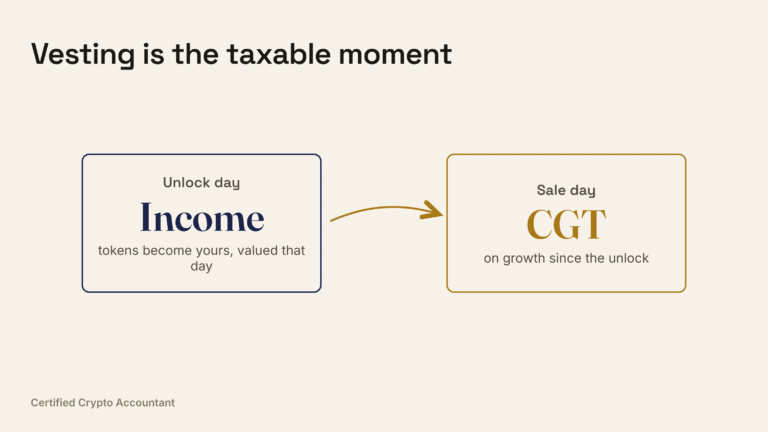
When you receive staking rewards, you have an income tax event. The GBP value at receipt is your income. When you later sell those rewards, you have a capital gains tax event. Your capital gain is calculated from the GBP value at receipt (your cost basis) to the sale proceeds.
Here is a concrete example.
You receive 0.5 ETH in staking rewards in October 2024. ETH is trading at £2,800. That is £1,400 of miscellaneous income, declared in the 2024-25 tax year.
You sell that 0.5 ETH in March 2025 when ETH is at £3,200. Your sale proceeds are £1,600. Your cost basis is £1,400 (the value already taxed as income). Your capital gain is £200.
You pay income tax on the £1,400 when you receive it. You pay capital gains tax on the £200 increase when you sell. Two tax events, one set of tokens.
Most people only report the capital gain. The income tax element is what gets missed.
Different Types of Staking: Different Rules
Not all staking is treated identically. There are three main scenarios.
Centralised exchange staking (Coinbase, Kraken, Binance)
This is the most straightforward. Each reward credited to your account is a separate income event. The GBP value at that date is your income for that transaction.
Koinly handles this reasonably well when your exchange is connected correctly. The most common error is staking rewards being imported as plain received transactions without an income classification, which means they do not appear in the income section of your report.
Native ETH validator staking
If you run an Ethereum validator or staked directly on the network, the timing of when rewards are received depends on when you had possession and control of the tokens. Prior to the Shapella upgrade in April 2023, ETH staking rewards were locked and could not be withdrawn. HMRC considers receipt to occur when tokens become withdrawable, not when they are earned. This means many early ETH stakers saw their staking income crystallise all at once in the 2023-24 tax year.
Liquid staking through Lido, Rocket Pool, and similar protocols
This is the most complex scenario and the one most frequently mishandled by crypto tax software.
When you stake ETH through Lido, you receive stETH in return. HMRC may treat this exchange as a disposal of your ETH. That means a potential capital gains event at the point of staking itself, before you receive any rewards.
Additionally, stETH rebases daily to reflect accumulated staking rewards. Each daily rebase is arguably a separate income event. If you held stETH for 365 days, that is potentially 365 separate income receipts.
Koinly commonly classifies ETH to stETH transactions as transfers rather than disposals. This is almost certainly incorrect under HMRC’s guidance, and it means a potential capital gain is going unreported.
If you have used any liquid staking protocol, those transactions need to be reviewed manually.
What to Check in Your Koinly Report
Before filing, run through this checklist.
Go to your transactions in Koinly and filter by the staking label. Confirm that every staking reward has a GBP value assigned at the date of receipt. Zero values mean missing cost basis and incorrect income figures.
Check your income summary page. Staking rewards should appear as a separate line under miscellaneous income. If they appear only in your transaction list but not in the income summary, they have been miscategorised.
If you used liquid staking, locate the token swap events (ETH to stETH, ETH to rETH, etc.) and check how they are classified. If they are labelled as transfers, that needs to be corrected.
Finally, sense-check the total staking income figure against your own estimate. If you staked for a full year and the income number looks unusually low, something is likely missing.
For the wider picture, how crypto tax works in the UK covers disposals, income and reporting in one place. For a figure, the capital gains tax calculator is free and takes a minute.
Staking questions we get asked
Do I pay tax on staking rewards I have not sold?
Yes. The reward is income at the moment it becomes yours, valued in pounds on that day, whether or not you ever sell it. Selling later is a separate capital gains event on any growth since.
What if my rewards were tiny each day?
The rule does not change with size, but the practical answer usually does. Rewards accruing daily need a pound value per receipt, which is why exchange data and a proper reconciliation matter more than the tax rate does.
Is staking through an exchange treated differently to running my own validator?
It can be. Exchange staking is normally straightforward income. Running infrastructure at scale starts to look like a trade, which changes both the charge and the reliefs, and that judgement turns on the badges of trade.
Does the value at receipt matter after I have paid income tax on it?
It matters twice. It is the amount charged to income tax, and it becomes your acquisition cost for the later disposal. Lose that figure and the capital gains calculation overstates your gain.
Sources
Every figure on this page was checked against the source below on 25 August 2026.
- Cryptoassets Manual (CRYPTO21200). GOV.UK, checked 25 August 2026
- The LITRG cryptoassets guide. Low Incomes Tax Reform Group, checked 25 August 2026
- 2023-14. Internal Revenue Service, checked 25 August 2026
Fahad Zar
Crypto tax accountantAAT licensed 1010475
- AAT Licensed Accountant and MAAT, licence 1010475
- MSc Accounting and Finance, BPP University London
- Six years inside digital asset accounting, across several crypto tax firms
- Practises through Zar Enterprises Ltd, ICO registration ZC225094
- Supervised for anti-money laundering by the AAT
What matters to me is that the number on the return is true, whatever it turns out to be.
Whether this is worth a conversation
Most people who read this page do not need an accountant. A few do.
- Rewards arrived and nothing recorded their value
- Your platform calls your staking a sale
- You cannot tell income from gains anymore
If you earned a few pounds of rewards sitting under the £1,000 allowance, note it and move on.
If one of these is you, the first look costs nothing.
Read next
Is your DeFi yield income or capital in HMRC’s eyes
DeFi tax in the UK explained: lending, staking, liquidity pools and yield. Where HMRC guidance draws the line between…
Reviewed 25 Aug 2026Deep guideAdding liquidity to Uniswap is a taxable disposal
Adding and removing crypto from a liquidity pool can each be a taxable disposal under HMRC rules. How LP tokens,…
Reviewed 25 Aug 2026Deep guideHow HMRC taxes lending and borrowing on Aave and Compound
Crypto lending and interest rewards are taxable in the UK, and the loan itself can trigger a disposal. How HMRC treats…
Reviewed 25 Aug 2026Deep guideCrypto Margin, Futures and Leverage Tax UK Explained
How HMRC taxes crypto margin, futures and perpetuals in the UK. When it is Capital Gains, when it is income, and why…
Reviewed 25 Aug 2026